
 Facebook
 X
X
 Pinterest
 Copy Link
One of the questions I hear most often is:
“What is your negotiation strategy?”
The honest answer is that I do not have just one.
After nearly 1,000 real estate transactions, I have learned that great negotiation does not come from following a script. It comes from understanding the people, the property, the timing, and what each side truly needs.
Every transaction is different because every person is different.
There Are Four Primary People in Every Negotiation
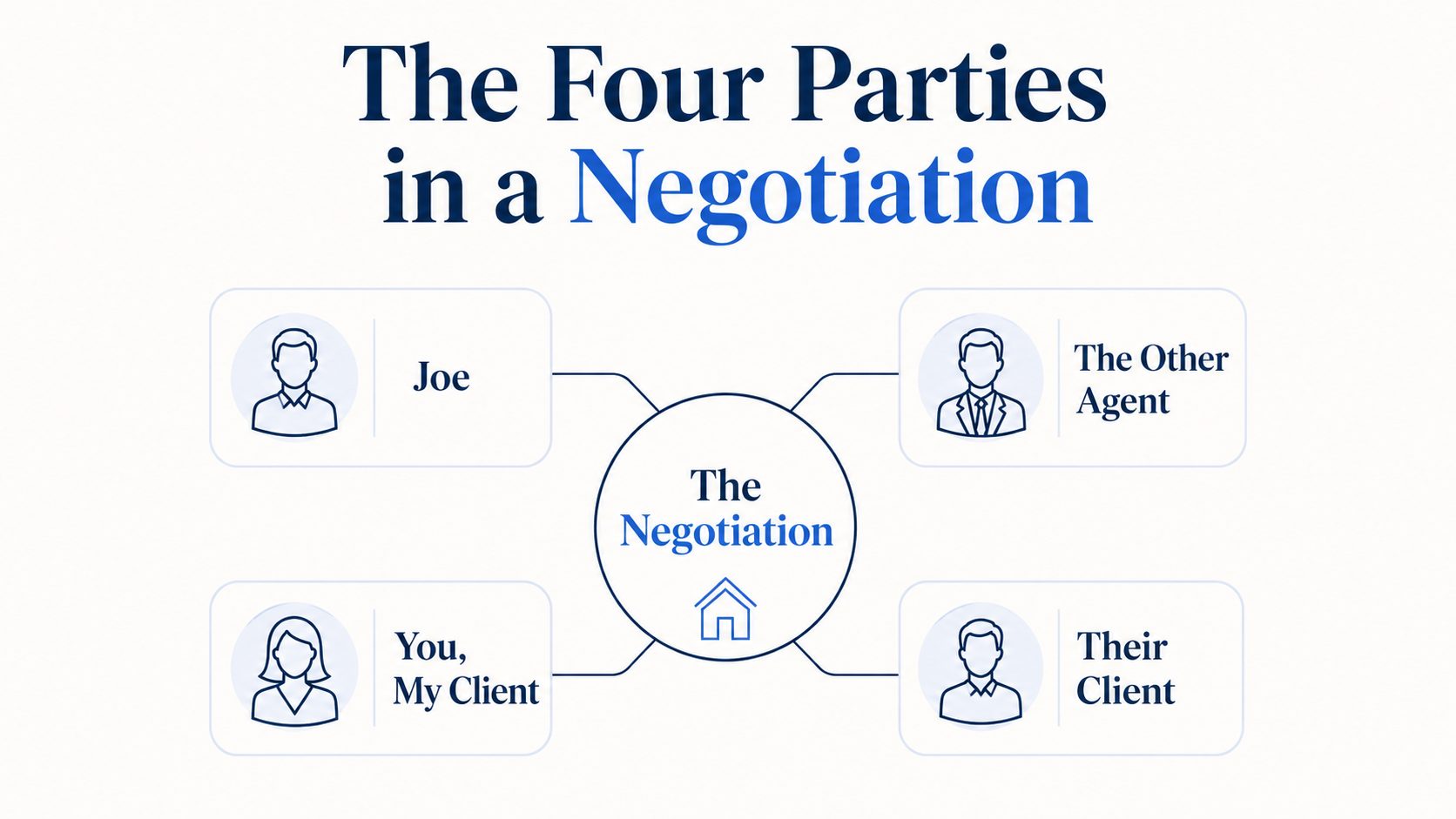
At the center of most real estate negotiations are four primary people:
The buyer.
The seller.
The buyer’s agent.
The listing agent.
Each person enters the transaction with different goals, concerns, pressures, personalities, and timelines.
A buyer may be worried about paying too much. A seller may care more about certainty than squeezing out the final few thousand dollars. One agent may be direct and fast-moving, while the other needs time and detail before making a recommendation.
That is why negotiation cannot be reduced to one clever phrase or tactic.
The first job is to understand who is sitting at the table.
The Highest Offer Is Not Always the Best Offer
People often assume that negotiation is primarily about price.
Price matters, but it is only one part of an offer.
A seller may care about:
- A quick or delayed closing date
- The amount of earnest money
- Financing strength
- Inspection terms
- Appraisal risk
- Possession after closing
- The likelihood that the buyer will perform
The highest offer can still be the weakest offer if it contains too many opportunities for the transaction to fall apart.
The best offer is usually the one that gives the seller the strongest combination of price, terms, certainty, and likelihood of closing.
For a buyer, the question is not simply, “How much should we offer?”
The better question is:
“What does this seller need in order to accept our offer, and can we meet those needs while still protecting you?”
That is where thoughtful negotiation begins.
The Human Layer Changes Everything

Great negotiations start with understanding people.
Negotiation is not just about numbers and contract language.
It is also about motivations, deadlines, fear, risk, communication, and relationships.
A family selling a longtime home may be making an emotional transition. A buyer may have already lost several homes and feel pressure to act quickly. A seller may need the proceeds from one home before purchasing another. Someone may be relocating for work, going through a divorce, managing an estate, or trying to coordinate a move around the school year.
Those details matter.
They help determine which terms are valuable and where flexibility may exist.
The goal is not to manipulate the other side. The goal is to understand the full situation well enough to create the strongest possible outcome for the client I represent.
Good Negotiators Adapt
This is why I am cautious when people talk about having a single negotiation strategy.
There is no universal strategy.
There are hundreds of possible approaches, and the right one depends on the specific transaction.
Sometimes the right move is to act quickly.
Sometimes it is better to slow the conversation down.
Sometimes price is the strongest lever.
Sometimes certainty, timing, repairs, possession, or fewer contingencies matter more.
Sometimes the best response is not to respond immediately at all.
My job is to listen, identify what matters, and help my client focus their energy in the right place.
Experience does not give you a perfect script. It gives you judgment.
It helps you recognize patterns, anticipate problems, and see the potholes before you hit them.
Negotiation Is About the Best Possible Outcome
The best negotiation is not always the one where one side feels defeated.
It is the one that protects my client’s interests and creates the strongest path toward a successful closing.
That means understanding the market, the contract, the property, and the people involved.
It also means knowing when to push, when to pause, when to ask another question, and when to change the strategy completely.
My clients do not hire me because I have a script.
They hire me because I know when to change it.
Thinking About Buying or Selling?
Every move begins with a different set of needs, tradeoffs, and opportunities.
My role is to listen first, help you understand the decisions in front of you, and develop a strategy that gives you the strongest opportunity for success.
My role is to listen first, help you understand the decisions in front of you, and develop a strategy that gives you the strongest opportunity for success.
Helping people succeed.
Where I manage. Where I coach. Where I sell.
